Why Is Multilingual AI Support Essential by 2025?
By 2025, 75% of global customers expect native-language support — making multilingual AI essential for competitive sustainability.
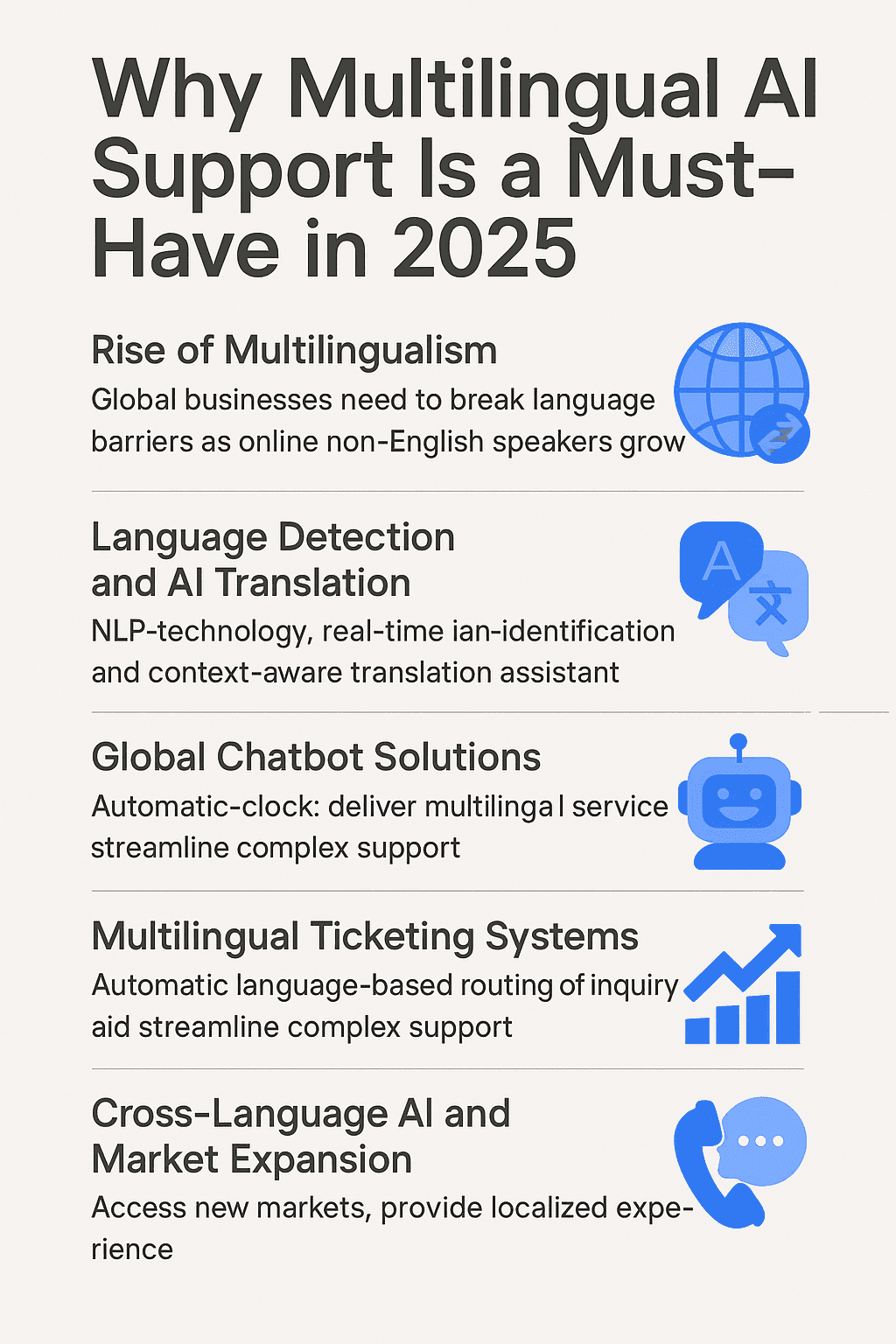
Why Multilingual AI Support Is a Must-Have in 2025
In the burgeoning digital economy, the integration of artificial intelligence has become pivotal for organizations seeking to enhance customer support. Among these innovations, multilingual AI support is emerging as a foundational technology — especially as we approach 2025. As global operations become the norm, accommodating diverse language needs is not only critical for customer satisfaction but vital for long-term competitiveness.
TL;DR: Multilingual AI support becomes essential by 2025 as businesses globalize and 75% of customers expect native-language interactions. This technology enhances customer satisfaction, optimizes operational efficiency, and expands market reach in the multilingual digital economy. Organizations adopting advanced multilingual AI gain competitive advantages through improved trust and communication across diverse language needs.
Key takeaways:
- 75% of global customers expect native-language support by 2025
- Multilingual AI is foundational technology for global operations
- Language accommodation is critical for long-term competitiveness
- Digital economy expansion requires diverse language capabilities
The Rise of Multilingualism in Global Business
The expansion of global marketplaces has made breaking language barriers a business imperative. By 2025, non-English speakers are expected to dominate the online population, making multilingual engagement essential. A report by Common Sense Advisory revealed that 60% of consumers rarely or never buy from English-only websites — a statistic that underlines the urgency of multilingual capabilities.
Businesses are now leveraging multilingual AI support to ensure frictionless global interactions. Features like automated language detection empower platforms to instantly identify a customer’s language preference and tailor responses accordingly, driving inclusivity and user satisfaction.
Language Detection and AI Translation: The Cornerstones
Modern multilingual AI systems rely on two foundational technologies:
- Language Detection: Powered by NLP, AI systems can detect over 100 languages in real time, offering seamless entry points for multilingual conversations.
- AI Translation Support: Unlike simple word-for-word translations, AI models now deliver context-aware, culturally sensitive communication — essential for truly personalized experiences.
According to McKinsey, personalization drives a 5–15% revenue uplift, making AI translation a revenue enabler as well as a support solution.
Global Chatbot Solutions for 24/7 Multilingual Service
AI-powered global chatbots enable businesses to deliver consistent, multilingual service around the clock. These bots:
- Manage high volumes of queries in multiple languages simultaneously
- Collect relevant customer data for faster resolution
- Provide real-time answers, freeing human agents for more complex tasks
Gartner predicts that by 2025, 80% of customer interactions will be handled by AI, making multilingual chatbots a must-have for scalable customer engagement.
Multilingual Ticketing Systems: Streamlining Complex Support
In scenarios where escalation is necessary, AI-driven multilingual ticketing systems ensure that the handoff is smooth and language-appropriate:
- Language-based Routing: Inquiries are automatically assigned to agents with the right language skills
- Auto-Translation: Tickets are translated for agents and customers as needed
- Efficiency Gains: Language-specific tagging and priority sorting improve overall support productivity
This integration not only improves customer satisfaction but also enhances internal workflow efficiency.
Cross-Language AI and Market Expansion
Cross-language AI solutions empower businesses to confidently enter non-English-speaking markets without building separate language-specific infrastructures. Key benefits include:
- New Market Access: Companies can now compete in regions previously limited by language
- Localized Experience: AI ensures cultural nuance in communications, increasing brand affinity
- Higher Conversion Rates: Users are more likely to purchase when supported in their native language
This is not just a technological upgrade — it's a strategic enabler for international growth.
Building Trust Through Multilingual Communication
Trust is a core pillar of customer loyalty. Communicating in a customer’s native language fosters:
- A sense of inclusion and respect
- Stronger emotional connection with the brand
- Reinforced reputation as a culturally aware and forward-thinking business
Multilingual AI enhances this relationship by removing language as a barrier, reinforcing the human element of global business.
Supporting Compliance and Legal Clarity
In many jurisdictions, legal compliance requires communication in official regional languages. Multilingual AI support ensures:
- Translations meet local legal standards
- Data handling aligns with regulations such as GDPR or CCPA
- Organizations minimize liability and build customer trust through clarity
In highly regulated sectors like fintech, healthcare, or insurance, multilingual AI is as much about risk mitigation as it is about convenience.
What’s Next: Innovations Shaping the Future
By 2025, multilingual AI support is set to evolve in the following key ways:
- Sentiment Analysis: AI will better detect tone, urgency, and customer emotion across languages
- Predictive Language Models: Anticipate user questions and provide proactive responses
- Immersive AI Experiences: Integration with AR/VR to offer multilingual virtual assistants
- Hyper-Personalized Assistants: AI agents that adapt to dialects, slang, and user behavior over time
These innovations will not only improve service delivery — they will redefine what customers expect from global brands.
Conclusion: From Trend to Strategic Imperative
In today’s digital-first economy, multilingual AI support is no longer optional. It’s a competitive differentiator that empowers:
- Better customer experiences
- Global scalability and operational efficiency
- Sustainable market expansion
By integrating tools such as language detection, contextual translation, global chatbots, multilingual ticketing systems, and cross-language AI, forward-looking businesses are setting themselves up for international success.
Try Twig for free now to experience how multilingual AI can future-proof your customer support operations and unlock global growth.
See how Twig resolves tickets automatically
30-minute setup · Free tier available · No credit card required
Related Articles
Top 10 AI Chatbot Platforms for Customer Service in 2026
The top 10 AI chatbot platforms for customer service in 2026, ranked by conversational quality, multi-channel support, self-service, and resolution rates.
10 min readTop 10 AI Customer Service Automation Platforms for 2026
Discover the top 10 AI customer service automation platforms for 2026. Ranked by ticket deflection, autonomous resolution, and workflow automation.
9 min readTop 10 AI Customer Support Platforms Ranked for 2026
The definitive ranking of the top 10 AI customer support platforms for 2026, comparing Twig, Decagon, Sierra AI, Intercom Fin, Ada, Zendesk AI, and more.
9 min read